
A “dummy” hotel booking for a Schengen visa is a real, refundable reservation that you cancel once your visa is decided. In 2026 it remains the safest way to show proof of accommodation without paying for hotel nights you may never use. This guide explains how to get one, what it must contain, what consulates check, and the mistakes that cause refusals.
Quick Answer: How to Get Dummy Hotel Booking for Schengen Visa in 5 Steps
- Choose the Schengen country that is your main destination (or where you spend the most nights). That consulate decides your visa.
- On a booking site, filter for free cancellation and pick a hotel in the city you will actually visit.
- Enter your name exactly as on your passport, with dates matching your flight itinerary.
- Check the confirmation shows your name, hotel address, phone, check-in/out dates and a booking reference.
- Keep the free-cancellation deadline in your calendar, and cancel only after you have the visa (or a refusal).
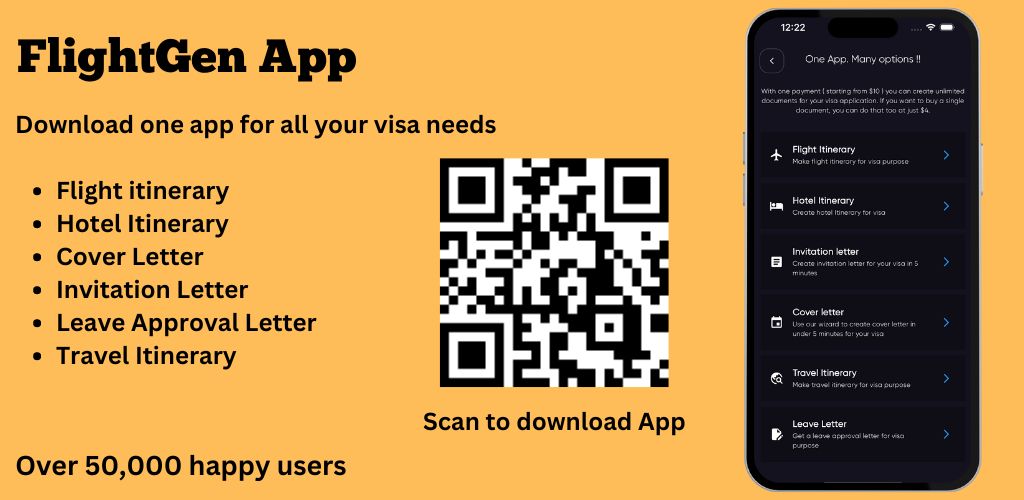
FlightGen helps you prepare your visa paperwork in one app: itineraries, cover letters, invitation and NOC letters, and hotel booking documents. Pay $3 per document, or $10 a month for unlimited documents.
What Is a Dummy Hotel Booking for Schengen Visa?
A dummy hotel booking is a temporary reservation made to document where you will stay, without committing money. Applicants use it because visa decisions can take 15 days or more, and itineraries often change. If the visa is refused, you lose nothing. If it is approved, you can keep the booking, change it, or cancel it.
The important distinction is between two things that get the same nickname:
- A real reservation with free cancellation exists in the hotel’s system, has a confirmation number, and can be verified by a phone call or email. This is what consulates expect.
- A document that only looks like a reservation has no booking behind it. If a consulate checks and finds nothing, your application can be refused for submitting false information, and you may be flagged in the Schengen visa database for future applications.
Everything below is about the first kind.
Do You Need a Hotel Booking for a Schengen Visa?
Yes. Proof of accommodation is a standard document for a short-stay (Type C) Schengen visa, and consulates such as Greece’s mission in Kenya and Spain’s consulate in Melbourne list it explicitly. Consulates accept different forms of it:
- Hotel or hostel reservations covering your whole stay
- A rental or Airbnb confirmation
- An invitation or declaration of hospitality from a host (some countries, such as Spain and Italy, require their own official form)
There is also a financial reason to include it. Some countries scale the daily funds you must prove by your accommodation situation. France, for example, uses €120 per day with no accommodation proof, €65 with a hotel booking and €32.50 with a host, and Spain’s 2026 figure is €122.10 per day, according to Wego’s 2026 proof-of-funds guide. A clear booking can therefore reduce the amount you need in your bank account. Always check your consulate’s current figure.
Is a Dummy Hotel Booking Legal?
Yes, when it is a genuine reservation you made under your own name and intend to cancel or change if plans change. Booking with free cancellation is ordinary practice and is not fraud.
It becomes a problem when the document is fabricated, edited, or made in someone else’s name. Consulates can and do verify bookings by contacting the hotel or the booking platform. A refusal for false documents can follow you into later applications, so the cheapest-looking shortcut is the most expensive one.
Why Consulates Ask for Proof of Accommodation
- To verify your travel intentions. A planned place to stay confirms a genuine trip and lowers the risk of illegal immigration.
- To check financial preparedness. Arranged accommodation shows you have planned and budgeted for the trip, and it feeds into the funds you must show.
- For public safety. Once your intention to travel is confirmed, authorities know where visitors are staying.
Should You Pay for All Hotels in Advance?
No. Do not prepay non-refundable hotels in the Schengen Area before your visa is cleared. If the visa is refused, you may lose all or most of the deposit. A refundable booking avoids that risk.
5 Ways to Get a Dummy Hotel Booking for Schengen Visa
| Method | Cost | Best for | Watch out for |
|---|---|---|---|
| Booking platform with free cancellation (Booking.com, Agoda, Expedia, Hotels.com) | Free until the deadline | Most applicants | Deadline passes silently; some hotels charge a no-show or card hold |
| Booking directly with the hotel | Free to low | Small hotels, longer stays | Get the cancellation terms in writing |
| Airbnb or rental with free cancellation | Free until the deadline | Apartment stays | Host confirmation must show full address and dates |
| Travel agent | Service fee, often $10–$30 | Group or family applications | Confirm the booking is real and ask for the reference number |
| Paid reservation or itinerary service | Varies | Anyone who wants help with formatting | Only use one that creates a real, verifiable reservation (see below) |
1. Booking Platforms with Free Cancellation
This is the most reliable method. Search your destination, then switch on the free cancellation filter and choose “pay at the property” where offered. Read the cancellation deadline on the confirmation, not just the search page. If your visa decision may arrive after that deadline, extend or rebook rather than let a paid charge land.
2. Booking Directly with a Hotel
Email a hotel, explain that you are applying for a visa, and ask for a reservation confirmation with free cancellation. Many small hotels agree. Keep the reply as proof, and make sure it names you, the dates and the property address.
3. A Rental, Airbnb or Host
Airbnb confirmations are accepted by most consulates if they show the host’s name, full address and your dates. If you are staying with friends or family, ask for the consulate’s invitation or hospitality form instead of a hotel booking.
4. A Travel Agent
Agents can book and hold a hotel for you, and the confirmation comes from a recognizable company. Ask for the booking reference and the hotel’s own confirmation.
5. Paid Dummy-Booking and Itinerary Services
Apps and websites that create hotel or flight “reservations” for visa applications vary widely. Before paying anyone, check three things: does the document carry a booking reference that the hotel or airline can look up, does it match your passport name and dates, and does the provider say in writing what happens if the consulate verifies it? A PDF that cannot be verified is not proof of accommodation, however good it looks. Read recent reviews first.
What Your Booking Must Show
Consulates reject proof that is vague or inconsistent. Before you submit, check that the booking has:
- Your full name exactly as on your passport (and every traveler’s name for a group)
- The hotel’s full name, address, phone number and email
- Check-in and check-out dates that cover your whole stay
- A confirmation or booking reference number
- The cancellation policy
- Dates that match your flight itinerary, travel insurance and cover letter
If you visit several Schengen countries, book at least the first nights in the country that will process your visa, and cover the full stay across the others.
Common Mistakes That Cause Refusals
- Submitting an edited or unverifiable document. Consulates check bookings, and a failed check is treated as false information.
- Booking in the wrong country. Your accommodation should match the country you apply to, based on where you spend the most nights.
- Not reading the cancellation policy. A “free” booking can still charge a card hold, deposit or no-show fee.
- Cancelling too early. Some consulates re-check bookings during processing. Wait until you have the decision.
- Gaps in the stay. Missing nights make the itinerary look incomplete.
- Mismatched dates. A hotel booking that does not match your flights is a common reason for follow-up questions.
- Treating accommodation as the whole application. Funds, insurance, employment ties and purpose of travel decide the outcome far more than the hotel.
Pros and Cons of a Dummy Hotel Booking for Schengen Visa
| Pros | Cons | |
|---|---|---|
| Money | No prepayment before the visa is approved | Hidden fees or card holds if you misread the terms |
| Risk | Nothing lost if the visa is refused | Hotel may cancel or release the room before the decision |
| Flexibility | Easy to change once you have the visa | Some consulates ask for paid or confirmed stays |
| Acceptance | Widely accepted as proof of accommodation | Unverifiable bookings can cause refusal |
When to Book a Real, Paid Hotel Instead
A refundable booking is not always the right tool. Book a real, paid stay (or follow the consulate’s own form) when your consulate states it wants confirmed or prepaid accommodation, when you are staying with a host who must complete an official invitation, when your trip is short and fixed, or when you are traveling at peak season and rooms may sell out.
What Changed for Schengen Applicants in 2026
| Change | What it means for you |
|---|---|
| Visa fee stays at €90 for adults | €45 for children 6–11, free under 6 (Leeds guide, Expatica). Visa centres (VFS, TLScontact) add a separate service fee. |
| Digital visa rollout | Italy moved to a fully digital process from 1 June 2026. The EU-wide application platform (EU VAP) is expected around 2028 (Wego, FTN News), so most applicants still use the current consulate or visa centre process. |
| EES at the border | The Entry/Exit System began on 12 October 2025 and records biometrics and overstays, so itinerary and stay dates matter more (DLA Piper). |
| ETIAS | Applies only to visa-exempt travelers (fee €7, expected from late 2026). It does not replace a Schengen visa and does not need a hotel booking (VisaFoto). |
| Proof of funds | Several countries have raised or tightened daily amounts (Spain’s 2026 figure is €122.10 per day), so check your consulate’s page (Wego). |
Rules, fees and processing times change, so confirm everything on your consulate or visa centre’s official page before you apply.
Where FlightGen Fits
FlightGen is an app for preparing visa paperwork: flight and travel itineraries, hotel booking documents, cover letters, invitation letters and NOC letters, from $3 per document or $10 per month for unlimited documents.
If you use any document generator, check that the names, dates and hotel details match your flights and insurance, and keep a way to prove the booking if the consulate asks.
Download the FlightGen app
Other Documents for a Schengen Visa
- Completed and signed Schengen visa application form
- Passport valid at least 3 months beyond your departure, with two blank pages
- Recent passport photos meeting Schengen standards
- Return flight reservation or itinerary
- Proof of accommodation
- Travel medical insurance covering at least €30,000 across the Schengen Area
- Bank statements (usually the last 3 to 6 months) and proof of income
- Cover letter explaining the purpose and plan of your trip
- Employment letter or NOC, or proof of enrollment
- Visa fee receipt
- Extras by visa type: invitation letter (business or family visit), acceptance letter (student), proof of relationship (family visit)
Apply up to 6 months before travel and at least 15 calendar days before; many consulates recommend earlier, so book your appointment first. Exact lists vary by consulate and visa type, so compare this one with VisaFoto’s Schengen requirements and your embassy’s own page.
Frequently Asked Questions
Is a Dummy Hotel Booking Legal for a Schengen Visa?
Yes, if it is a genuine reservation in your name that you cancel or change if plans change. Fabricated or edited documents are not legal and can lead to refusal and a record in the visa database.
What is Proof of Accommodation for a Schengen Visa?
A hotel or hostel booking, a rental agreement, or a host’s invitation for your whole stay, with your passport name on it.
Can the Embassy Check my Hotel Booking?
Yes. Consulates can contact hotels or booking platforms to confirm a reservation, so it must exist and match your documents.
Should I cancel my Dummy Booking after I get the Visa?
Only if you have other accommodation arranged, and only before the free-cancellation deadline. Border officers can still ask for proof of where you are staying, so keep a valid booking for the trip.
Can I cancel before I get the Visa?
Avoid it. Some consulates re-check bookings during processing.
Do I need a Hotel Booking for the Entire Trip?
Yes. Cover every night, or explain gaps (for example, nights with a host or on a train) in your cover letter.
How long can I stay with a Schengen Visa?
Up to 90 days in any 180-day period, so book accommodation only for the days you will actually be in the Schengen Area, and plan your exit date and return flight accordingly.
Can I use an Airbnb?
Yes, if the confirmation shows the host, full address and dates.
Can I change Hotels after I get the Visa?
Yes, but keep your trip broadly consistent with the itinerary you submitted.
How much does a Dummy Hotel Booking Cost?
A refundable booking you make yourself is free until the cancellation deadline. Agents and services typically charge a fee.
Does a Dummy Booking guarantee a Visa?
No. Funds, travel history, employment ties, insurance and the purpose of travel carry more weight than accommodation.
Can I use a Dummy Booking for other Visas?
Often, for the UK, Canada and similar applications, but rules differ, so check each country’s guidance.
Is a Dummy Booking the same as a Paid Reservation?
No. A paid reservation is charged in full when you book; a free-cancellation booking is not.
Which Schengen Country is easiest to get a Visa from?
Approval rates depend mostly on your nationality, history and docuiuments, and they change each year, so look at the published statistics for your own country of application.